guide
Rigging Truss Basics: What Event Buyers Should Know Before Ordering
Rigging Truss Basics: A Buyer's Guide for Rental Companies and Event Producers
If you are sourcing rigging truss for the first time — or replacing a mixed, mismatched inventory — the number of variables can be overwhelming. Box, ladder, triangle, spigot, bolt, 290mm, 400mm, 6082-T6. Every choice affects how the truss assembles, how it transports, and whether it integrates with what you already own.
This guide covers the fundamentals: truss types, connector systems, section sizes, and the five questions that prevent costly ordering mistakes. It is written for rental companies, event producers, and technical directors buying from an export manufacturer.
Guangzhou Benjie Stage Equipment Co., Ltd. has manufactured aluminum truss and stage equipment since 2015, as stated on the company website. Benjie Stage's aluminum truss range includes square, flat and triangle profiles in the BJF series, bolt truss (BJT14, BJT24-A, BJB30B) and Pre Truss (BJM36-A). This guide reflects the categories and options buyers work through most often.
The three main truss types
Box truss (square truss)
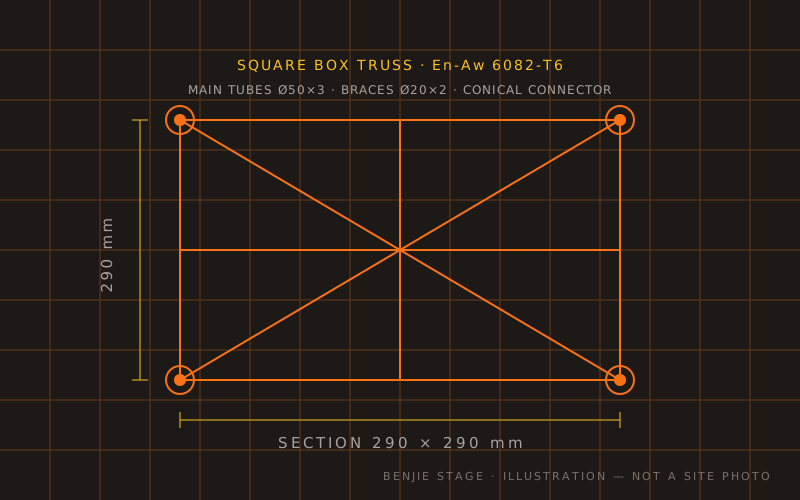
Box truss — also called square truss — has four chords connected by diagonal bracing on all four sides. It is the most common choice for rigging because it is strong in multiple directions and can carry loads both below and above the chord.
Square truss sections from Benjie Stage range from 100mm to 760mm. The most widely used sizes in rental fleets sit in the middle of that range. Box truss is the default for lighting grids, roof systems, and long spans where the truss must resist forces from more than one direction.
Ladder truss (flat truss)
Ladder truss has two chords connected by rungs, forming a flat, ladder-like profile. It is lighter and narrower than box truss of similar chord size, which makes it easier to handle and transport.
The trade-off is directional strength. Ladder truss is strongest in the plane of the ladder and much weaker sideways. It suits vertical applications, low-load spans, and situations where the truss will not be subjected to significant lateral force. For straightforward exhibition and display work, it is often the most efficient choice.
Triangle truss
Triangle truss has three chords in a triangular profile. It sits between box and ladder truss: more stable than a flat section, lighter and more compact than a comparable box section.
Triangle truss is common in smaller rigs, ground support, and applications where the visual profile matters as much as the structure. It is a practical option when a box truss would be over-specified but a ladder truss would not provide enough stability.
To see the full range in one place, Benjie Stage's Aluminum Truss page covers square, flat and triangle profiles, bolt truss and pre truss options.
Connector systems: conical, spigot, and bolt
The connector is the part of the truss that determines how fast it assembles, how repeatable the connection is, and how well it fits with truss already owned.
Conical connector (spigot + pin + R-clip). A conical spigot on one end of the truss fits into a receiver on the next section, held by a pin and R-clip. Assembly is fast, and no tools are needed. This is the most common system in rental and touring fleets because crews can build and strike quickly.
Bolt connector. Chords end in plates that bolt together. Bolt truss tends to be stiffer at the joint and is often chosen for permanent or semi-permanent installations where assembly speed matters less than rigidity. It requires tools and more assembly time.
Which one to choose? For a rental fleet, conical connectors are usually the practical default. For a fixed system, bolt truss is worth considering. The critical point: never mix connector systems within a single truss run unless the manufacturer explicitly confirms compatibility.
Comparing the three truss types
| Feature | Box (square) truss | Ladder (flat) truss | Triangle truss |
|---|---|---|---|
| Chords | Four | Two | Three |
| Strength in multiple directions | High | Low (strong in one plane) | Moderate |
| Weight and handling | Heaviest | Lightest | Moderate |
| Typical use | Lighting grids, roofs, long spans | Vertical spans, displays, low-load | Small rigs, ground support, visual profile |
| Connector options (Benjie range) | Conical | Conical | Conical (bolt on BJT/BJB bolt truss models) |
| Transport volume | Highest | Lowest | Moderate |
Use this table as a starting point. Final selection depends on span, load, and how the truss will be supported.
Section sizes, lengths, and span considerations
Section size refers to the overall width of the truss profile — for example, a 290mm square truss. Larger sections generally carry more load over a given span, but they also weigh more and take up more transport space.
Benjie Stage square truss sections range from 100mm to 760mm. Standard lengths run from 0.5m to 4m. Longer spans are built by joining sections, which is why the connector system matters so much: every joint is a point where the assembly's behavior changes.
Span is not just a function of truss size. It depends on:
- How the truss is supported (two points, multiple points, ground support)
- Where the load sits along the span
- Whether loads are static or dynamic
- Whether the truss is used as a single chord or as part of a system
This is why a buyer should never select truss by section size alone. It is also why the manufacturer or a qualified structural engineer should be asked to review non-standard configurations. A truss that works on one job may be unsuitable on another with different support and loading conditions.
Truss material matters too. Benjie Stage truss uses En-Aw 6082-T6 aluminum, with conical (spigot + pin + R-clip) or bolt connectors. These are standard alloys in the event industry.
The five questions that prevent costly ordering mistakes
1. What connector system does the existing truss use?
If truss is already owned, compatibility is the first question — not the last. A container of new truss that cannot connect to current stock is a costly mistake. Ask for the connector type, not just the truss size.
2. What is the actual span and load?
Span and load determine the required section size and truss type. "10 meters is needed" is not enough information. How many support points? What is hanging from it? Is the load centered or distributed?
3. How will the truss be transported and handled?
Larger sections cost more to ship and need more storage space. If crews build and strike frequently, assembly speed matters. Factor transport and labor into the decision, not just the purchase.
4. What accessories and interfaces are needed?
Truss rarely works alone. Base plates, sleeves, corner blocks, or adapters may be needed to connect to stages and other structures. Confirm what is included and what must be ordered separately.
5. What documentation and certification is required?
TUV certification is stated on the Benjie website; specific documentation should always be confirmed before ordering. If the market or client requires certificates, ask what is available. Never assume.
A short conversation covering these five points before ordering will save far more time than resolving a mismatch afterward.
Where truss fits in a wider inventory
Rigging truss is one part of a complete event inventory. Most buyers pair truss with Portable Stage systems, Crowd Control Barrier layouts, Aluminum Bleachers, and Scaffolding Tower units. When planning a full equipment package, reviewing these categories together helps standardize connectors and accessories across the fleet.
Project applications can also be reviewed to see how truss and stage systems are typically combined in real event configurations.
For specific questions about section sizes, connector compatibility, or ordering, reach out through the Contact page. The Benjie Stage team can confirm current product options and help match truss to existing equipment.
Key takeaways
- Box truss is the most versatile type; ladder truss is lightest but directional; triangle truss sits between them.
- Conical (spigot) connectors are the practical default for rental fleets; bolt connectors suit permanent installations.
- Never mix connector systems without explicit manufacturer confirmation of compatibility.
- Section size alone does not determine span — support points, load position, and configuration all matter.
- Confirm connector system, span and load, transport needs, accessories, and certification before ordering.
Choosing the right rigging truss is less about finding the biggest or cheapest option and more about matching the truss to actual use. Get the five questions answered first, and most ordering mistakes disappear before they happen.