comparison
Triangle Truss vs Box Truss: Which One Does Your Project Need?
Triangle Truss vs Box Truss
Choosing between triangle truss and box truss is one of the first decisions a rental company or event producer faces when specifying an aluminum structure. Both are made from the same family of aluminum alloys — typically En-Aw 6082-T6 — and both families are joined with conical (spigot, pin and R-clip) connectors in the Benjie range; bolt connection is offered on the BJT/BJB bolt truss models. What changes is the cross-section geometry, and that single difference drives load behavior, span capability, transport weight, setup time, and ultimately the cost of doing a job.
This guide compares the two formats practically, so you can match the right truss to concerts, exhibitions, DJ setups, and retail displays.
What each format actually is
Triangle truss uses three main chords arranged in a triangular cross-section, connected by diagonal bracing. Because one chord sits at the apex, the load path is asymmetric — strong in one direction, less so in the opposite. Common segments include the BJF33 and BJF43 triangles from Benjie Stage.
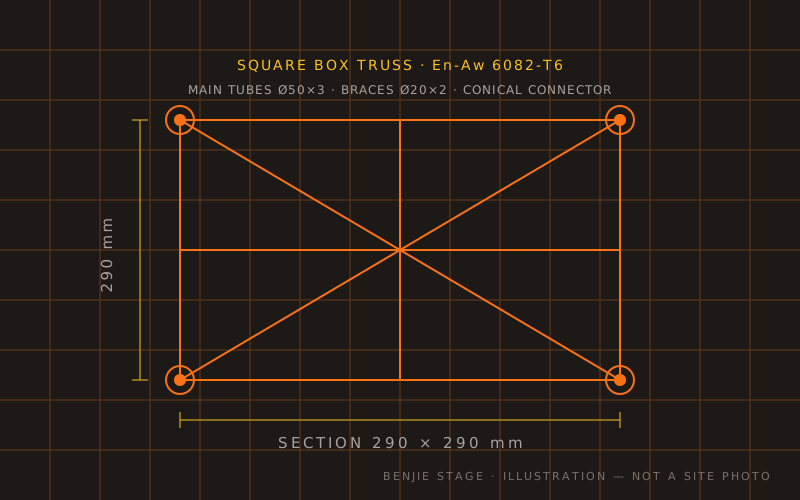
Box truss (also called square truss) uses four chords in a square cross-section. Benjie Stage manufactures square box truss across the BJF14 to BJF76 range, covering 100mm up to 760mm section sizes. The four-chord layout of a square section is symmetrical, so it behaves consistently no matter which face is loaded. Note that rectangular sections in the range (BJF64 400x600mm, BJF76 520x760mm) are directional — orientation matters for those.
Geometry and load behavior
Load behavior follows directly from geometry. A box truss has two chords in the top plane and two in the bottom plane, so bending forces are shared across a wider, symmetrical section. Deflection is more predictable, torsion is better resisted, and the truss stays stable when loads are applied off-center — which happens constantly in real rigging.
Triangle truss concentrates material into three chords. It is efficient for its weight and works well for vertical loading in one primary direction, but it twists more readily under eccentric or side loads. That asymmetry is not a flaw; it simply means triangle truss should be planned with the load direction in mind.
Practical consequence: box truss is the common choice for heavier rigging, while triangle truss suits lighter, directional, or decorative applications. Unpredictable or dynamic loads always require project-specific engineering regardless of section choice.
Typical spans
Span capability is a function of section size, chord diameter, wall thickness, bracing pattern, connector type, and the load applied — not of the triangle-or-box label alone. A large triangle section can outperform a small box section, and vice versa.
That said, the general pattern holds: for a given section size and comparable build, box truss tolerates longer spans and higher point loads because of its symmetrical four-chord design. Triangle truss suits shorter, lighter spans. Always confirm actual capacity against the manufacturer's engineering documentation for the exact series and configuration — never generalize from cross-section shape alone.
Weight and transport
Triangle truss is generally lighter per meter for a comparable duty because it uses three chords instead of four. That translates into real savings on truck space, fuel, and labor — especially for rental fleets that move stock daily.
Box truss is heavier, but a square section stacks and packs efficiently, and its four flat faces make it easy to couple and align. For long-haul touring, the weight penalty is often offset by faster load-in and more predictable handling.
Fleet tip: many rental companies stock both. Triangle for repetitive small-format work, box for the main hangs and structural spans.
Setup and assembly
In the Benjie range the triangle (BJF33, BJF43) and square (BJF series) families use conical (spigot + pin + R-clip) connectors; bolt connection is offered on the BJT14, BJT24-A and BJB30B bolt truss models.
- Conical connectors speed up assembly with fewer loose parts and are popular in rental environments where crews repeat the same builds.
- Bolt connectors provide a very rigid joint and are common where a structure stays assembled or where maximum stiffness is required.
Box truss on the ground is often easier to assemble because the four faces give natural reference points for squaring. Triangle truss can be faster to lift and position when light, but it needs attention to orientation so the apex faces the right way relative to the load.
Comparison table
| Factor | Triangle truss | Box truss (square truss) |
|---|---|---|
| Cross-section | Three chords, triangular | Four chords, square |
| Load symmetry | Directional; asymmetric | Symmetrical on all faces |
| Torsion resistance | Lower | Higher |
| Typical span tendency | Shorter, lighter duty | Longer, heavier duty |
| Weight per meter | Generally lighter | Generally heavier |
| Transport | Compact, light | Bulky but stacks well |
| Setup | Fast when light; orientation matters | Easy squaring, rigid joints |
| Best for | DJ, retail, light décor, small exhibits | Concerts, main hangs, large exhibits, LED walls |
| Benjie series | BJF33, BJF43 | BJF14–BJF76 (100–760mm) |
| Connectors (Benjie range) | Conical (BJF33, BJF43) | Conical (BJF series); bolt on BJT/BJB models |
Cost drivers
Cost in truss is driven by material volume, section size, chord specification, bracing complexity, connector machining, surface finish, and certification/documentation requirements. Triangle truss usually costs less per meter for a comparable section because it contains less material — but that advantage disappears if the job needs a larger triangle section to meet the same span as a smaller box section.
Other cost factors that apply to both:
- Section size — larger sections use more aluminum and cost more.
- Finish — silver, black, and gold are available; special finishes add processing.
- Connector type — conical and bolt systems have different machining and inventory implications.
- Accessories and compatibility — base plates, sleeves, corners, and couplers add up across a fleet.
- Logistics — lighter truss reduces freight and handling cost over the life of the asset.
For a rental fleet, total cost of ownership matters more than unit cost. A slightly heavier box truss that sets up faster and handles more jobs can be cheaper per event than a lighter triangle that limits what you can quote.
When to choose triangle truss
Choose triangle truss when:
- DJ setups and small stages — light spans, simple shapes, quick builds.
- Retail displays and showrooms — decorative frames, product lighting, branded structures where weight and visibility matter.
- Small exhibitions and pop-ups — short spans, light signage, and easy transport in a van or small truck.
- Architectural and décor features — where the truss is seen and the load is modest.
Pair triangle truss with a Portable Stage for compact event packages, or use it to frame retail and exhibition booths.
When to choose box truss
Choose box truss when:
- Concerts and touring — main hangs, side hangs, and any structure with significant point loads.
- Large exhibitions and trade shows — long spans, LED walls, and multi-point rigging.
- Structures needing predictable symmetry — where loads shift or crews rig from multiple directions.
- Permanent or semi-permanent installs — where rigidity and long-term stability matter.
Box truss is the natural partner to Aluminum Truss grids, Crowd Control Barrier layouts, Aluminum Bleachers seating, and Scaffolding Tower access structures on larger sites.
Mixing the two
There is no rule that a project must use only one format. A common approach is box truss for the primary span and triangle truss for decorative or secondary elements — for example, a box truss roof grid with triangle truss accents over a DJ booth. Confirm connector compatibility and engineering before mixing series.
If you are specifying a structure and want to confirm which Benjie series fits, review the options on the Aluminum Truss page or Contact the team with your span, load, and application details. You can also see how both formats are used in real installations on the Project applications page.
Key takeaways
- Box truss (four chords, square) is symmetrical and handles longer spans, higher loads, and torsion better; triangle truss (three chords) is lighter and suits shorter, directional, decorative work.
- Benjie Stage manufactures square box truss from BJF14 to BJF76 (100–760mm) and triangle truss in BJF33 and BJF43.
- Both formats use En-Aw 6082-T6 aluminum (BJT bolt models use 6061-T6 except BJB30B) with conical connectors on the BJF families, so choice is about geometry and application, not material.
- Triangle truss can offer advantages in transport weight and cost per meter, while box truss offers rigidity and setup predictability for heavier rigging — confirm with model-specific comparison when ordering.
- Match the format to the job — DJ, retail, and small exhibits to triangle; concerts, large exhibitions, and LED walls to box — and verify capacity against the manufacturer's documentation.